Showing posts with label Legend of Zelda. Show all posts

Sunday, July 3, 2011

Video Game Challenge!

It has been a long time but I am finally back. I have decided to take everything in a new direction rather than having very long posts, I am going to try and stick with nice short posts. Hopefully this will keep me active.

To Start I am doing a bit of a twist on the "30 Day Video Game Challenge" that you see on Facebook. I found there are a number of theses 30 day challenges and they all have different criteria. So I am going to take the best aspects out of all these challenges and create a series of posts.

My Favourite Game: The Legend of Zelda: Ocarina of Time


I know this will seem to some a very "obvious" and "typical" choice., but I have great memories of this game. I remember playing this game and thinking that there was nothing else out there remotely like it. It was the first game I played that felt like a living breathing world. Sure many games had towns to visit and people to talk to, but this game had a day/night cycle and helped the player feel like time was actually passing. The dungeons were so perfectly created, giving the player just enough challenge to feel a sense of accomplishment once beating it. It was the perfect game of its era, and still holds to the test of time.

If you want to read more about this game check out my earlier post.

Monday, April 20, 2009

The Legend of Zelda: Ocarina of Time

Before I get into writing about The Legend of Zelda: Ocarina of time (LoZ:OT), the orgins of the series have to be discussed. The Zelda series is another brainchild of Miyamoto, but it has a bit more of a personal connection to him. The first Zelda game on the NES was inspired by Miyamoto's own childhood. He spent a lot of time in his mother's garden playing and it was through these experiences that he got the idea for the game. This explains why all of the Zelda games have a strong tie to nature. Link even wears the colour green further grounding him in the natural setting.

The original Legend of Zelda game also was revolutionary in many ways. It was one of the first open-world games. Rather then having levels, the game just started off in a field and it was up to you where you went. The game was covered with tons of hidden areas and secrets and players spent hours discovering new things all the time. It also broke away from the traditional adventure games by not having your character level up. Usually in adventue games your hero gains experience from defeating enemies and therefore becomes stronger. In Zelda the way you gained power was through exploration. You discovered new items that gave Link new abilities. Rather than encouraging battles, this game rewarded you for exploring. Battling eniemes was part of the game but puzzle solving was the real attraction of the game.

The world of the Ocarina of Time

LoZ:OT was not only the first Zelda game to be 3D but one of the first adventure games in general. The game set the bar for what was expected afterwards and in many ways that bar still stands. LoZ:OT became the blueprint on how to make a vast adventure work. The new updated visuals made the world seem so new and real at the time, and the environment thrived because of this. The people in the towns each had a unique look and personality. Even characters that added nothing to the storyline still helped create the ambience of the background. The many dungoens in the game, large expansive Hyrule Field, the towns, and the many different intelligent species all added to making the game world feel real.

The over world map for the game. You can see how diverse the environments are.

A new touch that LoZ:OT had was the day/night cycle. It had been done in games before but this was the first game where it seemed most natural. At night more monsters would roam the field, shops would be closed, and new strange characters would be out to talk to. During the day Hyrule was lively and fun, with lots of people to see and realitively safe. It was a simple idea but the world seemed more real because of it. It gave the game a lot more depth and charm.

The game world also changes as you interact with it. You start off the game in Karakiko village which is guarded by the Great Deku Tree. Once you venture inside the tree and clear the monsters inside, you find out that it is the tree's time to die and some people in the village blame you for its death. At one point you find yourself in a whale's stomach trying to stop what is corrupting it. Once you save it the entire Zora village is extremely happy with you. There is a lake in the game that is completely dried up and its through beating the water temple that you bring life and water back to the lake. By having a real effect on the world around you makes you seem more important as a player.

Child/Adult

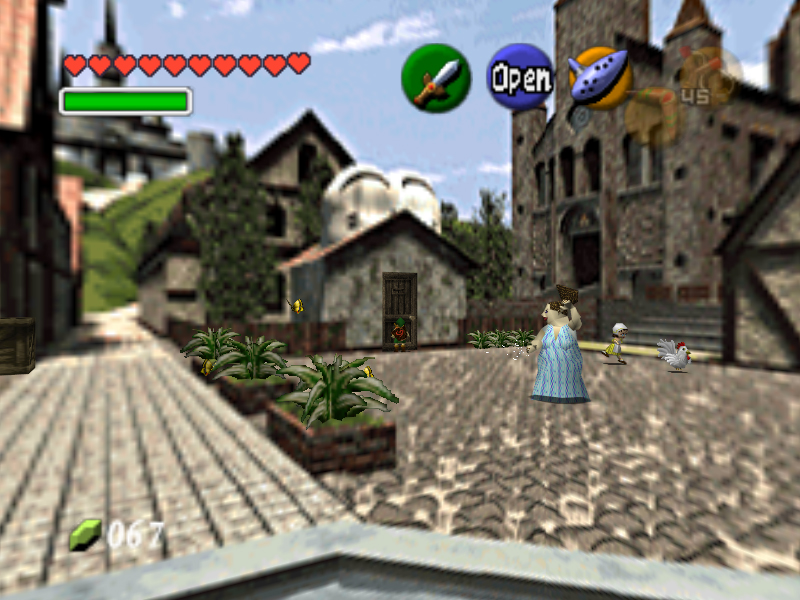
Hyrule Castle Town as a child

Part of what made the story so memorable was that you started the game as a child and ended the game as a late teenager. Since the story spanned several years it had a larger scope and effect. Young link's world was a lot more safe and fun to play in. Hyrule Castle town was a lively place that had a lot of people. The castle itself is grand and full of colour and beauty. In adult Link's world the town is plagued with the undead and no one is left alive. The skies swirl red and Hyrule Castle is taken over by the evil Ganon. As young Link you can visit the Zora's and adventure in their underwater society. When you are adult the Zora's seem dead and their village is frozen over. Overall young Link's world is light while adult Link lives in a dark world. This is much the same way we see the real world. As kids everything is a possiblity, we believe in monsters, see everybody as some unique new person, and are excited to play around outside. When we are adults we have to become a lot more serious and see the world as a much more stark place.
Hyrule Castle when you are an adult.

Save the Princess (10 year old spoilers)

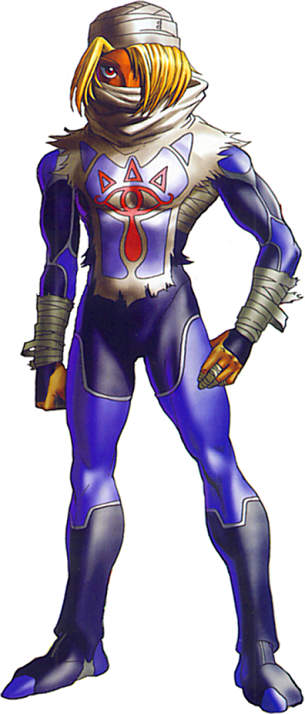
Zelda as Sheik. Not the typical look for a princess.

The typical Zelda game followed this storyline, "the princess Zelda has been captured by Ganon, go save her." LoZ:OT on the other hand, lead us to believe this was going to be the story and then turned it on its head. When you last see Zelda as a kid she is being taken away by Ganon. Once you are an adult a new character meets up with you from time to time. This new character is named Sheik. Sheik is seen as a strong and mysterious figure. Near the end of the game you find out that Sheik was Zelda all along. Now this is a basic plot line but including it in this game showed that the designers were ready to break away from their traditional stroy telling techniques. Rather then having Zelda be a weak damsel in distress, she is now Link's equal in many ways. Even later in the game you find that the Triforce, which is what Ganon wants to gain ultimate power, has become part Link, Zelda, and Ganon. All pieces of the triforce are equal giving Zelda equal standing to Link and the powerful Ganon.

Epona

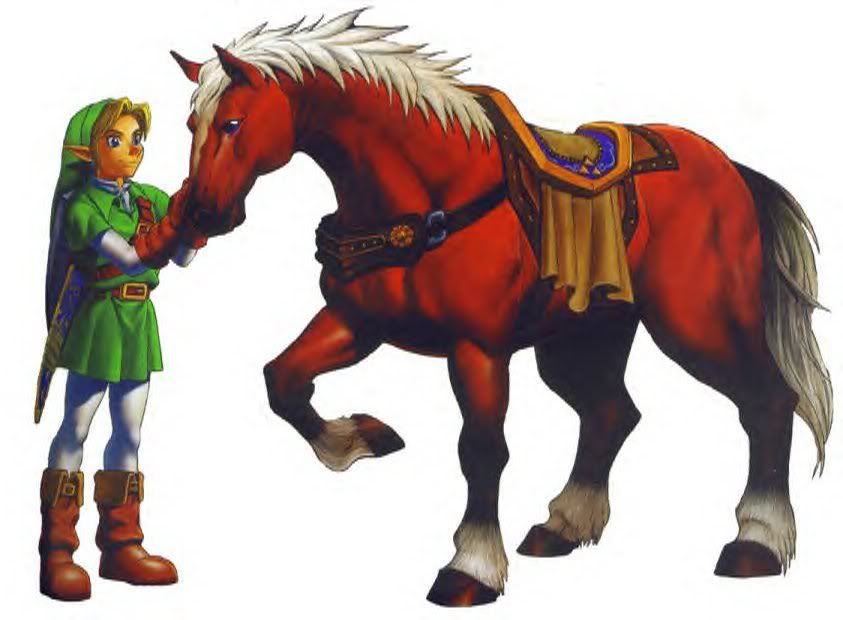
Epona is your horse, and throughout the game you become attached to it. You meet Epona as a child but rescue it as an adult. Once it is rescued you can call upon it whenever you want in order to ride it through the fields. Rather than making Link walk or run everywhere it was much more fun to ride Epona. The horse is your main vehicle but it also a living thing, it tires out if it ran to hard, and controls kinda stiff like a real horse would. Epona gallups toward you when called and has a little personality of its own.

The Ocarnia

The music in LoZ:OT is entrenched in the overall gameplay. The main item in the game is a musical instrument, the ocarnia of time. You actually play the ocarnia in order to progress in the game. You have to learn new songs, and even get to make up one of your own. Technically speaking you can use the ocarnia at any time and play any song (you have control over what notes it plays). Each song you learn is not only played on the ocarina but also in the background music in the game. Your songs can also directly effect objects in the game, and warp you to dungeons. By playing the song to warp you to the next area it is setting the mood of where you are going creating a smoother transfer from one different level to another. Moving from the forest temple to the fire temple, could throw the player out of the game. Both temples are very different and the music change is drastic. If you ride your way to the fire temple you will see the gradual change over time so the player gets the idea that time has passed and land has been covered. But if the game warped you directly without the ocarina it would seem like too much of a change, and unbelievable. By having Link play the fire temple's song it adds a layer to the transition making it less black and white.

All The warp songs in the game. You can hear how each song goes along with the element it represents.

The Legend of Zelda: Ocarina of Time, had a lot of time and care put into it. every aspect of the game was expanded on and created a unique experience that some say has never completely been matched. I remember playing this game when it first came out and it completely changed the way I saw other games. After LoZ:OT I expected more out of games, and other game worlds seemed very shallow standing next to it. I play through the game every other year or so and find that, other than the graphics (which like any technology becomes dated), the game still stands as one of the best all around experiences.

Friday, April 17, 2009

Music

I mentioned in my introduction why music is important to video games. I am going to expand on this topic and go through why video game music is so important to the artform. Music is in bascially every game, some times it plays a more significant part then in others. In some games music is just background noise to set the mood. In others, music is the game and the player has a more direct influence over how the music sounds. Both of these methods of video game music are equally important, and it all depends on the game which way the music should be used.

The Loop

Some games do not have a set time limit, or the time limit is so long that it's unrealistic to create one song to encompass the entire level. In these cases it is important for the musical composers to create a song that works as a loop. The song has to begin and end the same way. Not only does this effectively fill up a level of any length but also because of the content looping helps get the song in the gamers head making it memerable. The loop can have drawbacks if the loop is too short. It turns from catchy, fun, and classic, into annoying and irritating.

Timed Song

Some songs are timed for specific events. For example in Halo you go around with barely a note played but once a battle starts the music comes in. This makes the song not only stand out against the stark silence that came before but also sets the mood for the battle. Music can cue the player how to play, and the timed song does this the best. Having a song fade in or out and change depending on the atmosphere of the game can really inhance the mood. The oinly problem with the timed song is what to put in between one song and another, since they don't always mesh together.

Interactive Song

Now this is a very new and experimental type of gameplay that isn't used that much, most likely because it is difficult to pull off with great success. Now some rhythm instrument games like Guitar Hero, or Rock Band fall into this category. Those games have music as their main focus and it is fairly easy to set gameplay around it, press the buttons at the right time to make the music. This is not so much interactive music as it is a timing excerise. It's a lot of fun and gives the player the idea that he/she is actually playing the music. This is the most common type of interactive music.

The other form of interactive music does not require picture perfect timing and is a lot harder to pull off successfully. In these games the music goes along with the player no matter when the buttons are hit. Unlike the previous games the music always sounds different. Here are some games to give you a better idea what I am talking about.

Space Invaders Extreme


There is music in the background but hitting the enemies adds notes to the score. Different weapons provide different sounds. The music alone is just part of the overall picture and is only fully appreciated when playing the game.

REZ


A full on music game that only has a simple tune in the background. Shooting eniemes and leveling up make the music change as you play. You are essentially exploring the musical scores and manipulating it as you play the game.

Lumines


A puzzle game that adds different sounds as you break the pieces. The music gets more complex the better you do at the game. Also the blocks break at the speed of the beat of the game, so each level is different depending on the song.

Sound FX

Sound FX is probably the biggest challange for video game composers. Every time your character shoots, jumps, hits an enemie, dies, and many other things, a sound FX usually occurs. These sounds have to compliment the music in the game. While they do not directly effect the music they are still played on top of it. It would be jarring to hear a sound that does not go along with the overall score. This is why when Mario jumps it sounds different from when Sonic jumps, each sound effect has to go along with the music in their repective games. You are in control of the hero and its up to you how you play with it, the sound FX designer has to make sure every sound you can possibly make will fit into the musical score of the game.

Player's Mood

Everything I mentioned before is an answer for"how" video game music is used, but an equally important aspect is the "why." I touched on this aspect before in my intro blog post but I think that it is such an important part of the video game artform I have to also expand on this. If the composers have done their job properly not only will the music fit into the game thematically, and go together with the sound FX but also relay an emotion to the player. If you are going to have a level in a forest, the music should be light and fun, connecting the player to the mood of nature. When the player is in a lava level, light fun music won't cut it, you need a faster paced tune. If you are in a dark dungeon the music should have a dark or "echo" sound to it further bringing the player into the environment. The music should connect to the player by bringing him/her into the environment as well as letting the player know how much action to expect on the screen. So if you are in a light easy forest level but you are at the boss and the action has picked up the music should not stay all light and slow, it should pick up a bit while still maintaining the feel of the level. I will leave off this post with some examples of music effecting mood, and gameplay.

Shadow of the Colossus Boss fights

Then game is extremely silent for the most part. The silence ends however, when you finally meet up with a Colossus. The music stand out against the stark silence of the rest of the game, and gets the player ready for a battle.

Sonic First level


The music is much faster than most platformers. Sonic was also a much faster game than any before it. Helping the player get the idea that this game was meant to be played at high speeds was the music

Zelda Lost woods


A light song you hear on your way up to the forest temple and the surrounding area. The song, played mostly using wind instruments, helps connect the sound back to nature. This is a great piece that could not fit any better in the environment.

Metroid


One of the first open world side scrollers. This game was extremely difficult when I first encountered it because of its lack of any real direction, it really confused me at the time. The music is just as mysterious and dark as this game. Here is a sample from the game called "Kraid"

Duck Tales The Moon


One of the best tv series turned video game. One level has you searching through the moon for treasure. This song really captures the sci fi feel while keeping the action alive.

Music can do so much for a game. Whether it is setting the mood, or being an part of the gameplay it is an equally important part of the video game artform. Next time you play a game listen to the music and see how it matches your experience. Think back to songs you remember fondly, chances are you have a connection with them because not only were they beautifully compossed but also because they fit so well in the game's environment.

Monday, April 13, 2009

Silent Protagonist

When games first started out, practically none of the lead characters talked. Then again, no one really talked back to them. These are not the kind of silent protagonists I am going to discuss. There are some games that have large diverse worlds with thousands of lines of dialogue, and still the lead characters you control are mute. At first glance this seems like it would be completely useless and draw the player away from the game. Imagine watching an action movie where the hero was completely silent while everyone and everything around him/her was talking and making noise. It would be a jarring experience to say the least. It does not work that way in video games, in fact a silent protagonist can do a lot that a voiced hero cannot.

Are they truely silent?

The answer is both yes and no. "Yes" there is no audio coming out of the speakers from the voice of your character. But "no" this doesn't mean they aren't speaking. When someone in the game world approaches our player and talks to them even though our character isn't responding we are. In essence the protagonists voice is our inner dialogue. When we play video games we are constantly thinking; where should I shoot, how can I get out of this battle safely, where is the key for this locked door, where do I go next, what magic should I use and the list goes on forever. In a way that inner dialogue we have is also our silent protagonists dialogue. Since the character has no voice of his/her own its easier for us to pretend our inner dialogue is their voice, whether we do it subconciously or not. For example if we know the character we are playing has a high pitched cartoony voice chances are we are not going to think like that same voice while playing the game. When I play Super Mario I am not saying to myself, "Mama Mia, I have-a to jump now. Okey dokey." I know that when I am thinking that's my voice and when Mario is speaking, in his stereotypical Italian accent, that is him. But when playing a game with a silent protagonist there is no clear distinction between your voice and theirs. Having a silent protagonist is one of the best ways to ensure the player has a more personal connection to the protagonist. When another character in a game talks to the silent protagonist our emotional reaction becomes the hero's reaction. We are no longer forced to accept the characters emotional responses if they are different than the way we would behave.

Designing a Silent Protagonist

A silent protagonist does not have to have a specific look. But, many of them do. Calling it a "specific" look is somewhat of a misdomeaner since a silent protagonist should have an atypical look from other characters. Let's look at the threee most famous silent protagonists.

Gordon Freeman (Half Life Series)

One of the first things you may notice about Gordon is his anti-action hero look. Sure he has that tough looking armor on but he looks like a "nerd." I hate to say it,but a large portion of the video gaming public do consider themselves nerds in one way or the other. In a lot of ways we look a lot more like Gordon freeman then we look like most bulky muscle bound heroes. Gordon Freeman is just a scientest caught in a bad series of events and it is played out in a way to make it believable that it could happen to anybody. He looks like an average male with glasses, and he doesn't speak. Its fairly easy for most of us to picture ourselves as him. It's also important to mention that Half Life is a first person shooter, so we are looking through Gordon's eyes the entire game. Not only are we his voice but also his eyes.

Link (Legend of Zelda Series)


This one is a little different since he doesn't really look like any of us. Link isn't even human, but he does have mostly human features and is not a muscle bound hero. In the games, Link is either a child or in his mid teen years. This age range mimicks the typical age of video game players at the time Link was created (now gamers are much older). As child who grew up with the Zelda franchise it was easy for me to put myself in his shoes. More important to Link's silence than his appearence is the overall game design. The Legend of Zelda is a large scale adventure series that requires a lot of puzzle solving. Naturally in a puzzle game we have to think a lot harder and are constantly guessing what to do next. Our internal dialogue is extremely important when playing the Legend of Zelda. Therefore, it makes sense to further link us to the game by giving us a silent protagonist. It also is not a coincidence that his default name is Link either, Shigaru Miyamoto gave him that name because he felt like we should have a link with the character. Furthermore, technically speaking, his name can be changed into any name as we are given the option to do that when we start the game. Having the name Link, which symbolically links us, or giving him our own name, which directly links us, are enhanced by him being a silent protagonist.

Crono (Chrono Trigger)


Now it was a very strange move to make the lead in a RPG silent. RPGs are typically the most story driven games and have the most dialogue. The lead character in an RPG usually has a very distinct personality and the designers want to sell the character as a specific personality type. However, in Chrono Trigger this is all thrown out the window. The designers made Crono silent basically making him a stand in for ourselves. His silence also helps prop up the supporting cast. It lets Crono fade into the background a bit and forces us to pay more attention to the other characters around us. Chrono Trigger has a cast of very colouful characters and they stand out even more beside the silent Crono.