Not all game design choices are done 100% on purpose. Sometimes game designers have to make the best of a bad situation. When video games started to come on CDs (and now DVDs and Blu-Ray) it brought a lot more to work with. The major downside to these formats though was the loading time. Unlike game cartidges, CDs had a much longer and more noticable loading time. Loading can happen when any significant change in the game occurs. The game needs time to load the new information before it can display it. This causes a pause in the gameplay that is unavoidable. Some game designers took the loading time as a challange and made the best of it.
Blank Loading screen
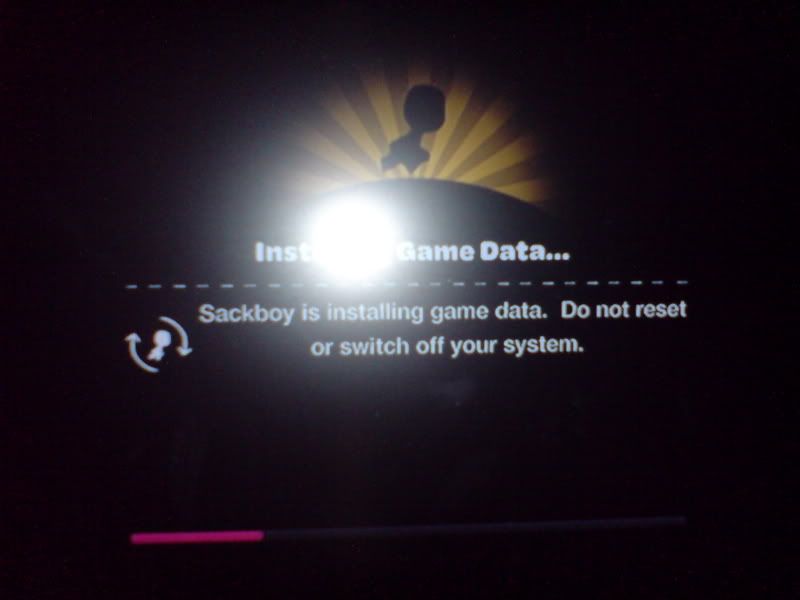
It is still used today and is probably the worst kind of loading. Rather than giving anything for the player to look at the screen is mostly blank with a simple loading text. Sometimes the logo of the game will be on the screen but looking at it can get very boring. Since the screen is basically static without much to do the loading time can actually seem longer than it really is. Try staring at a wall for 20 seconds. It obviously feels a lot longer than that, but if you are watching a movie for 20 seconds (especially an interesting movie) the time flys by. Sadly this type of loading is not extinct and a lot of developers still use this method. In their defence they may have not wanted to spend any time with the loading sequence and devert all their energy to the game itself.
Little Big Planet. A great game that everybody loves. But the black loading at the start of the game, feels much longer than it is.
Load it all at the start
Some bigger games know they are going to have a lot of loading. The game world may be so huge that the game designers don't want to stop the player every time he/she moves to a new area. A way to combat this is to load a large chunk of the game when the disc first starts up. This can lead to a long load at the beginning of the game but afterwards the loading moves much faster. This not only gets a lot out of the way, but it also helps keep the player in the game. One of the problems with loading is that the player is literally booted out of the game and forced to sit and stare. By having the loading at the beginning of the game the player is already out of the experience. He/she is not expecting to be playing as soon as the disc is booted up.
Grand Theft Auto is a large game with a highly detailed city. You move freely throughout the city so it is in the designers best interest to load up the majority of the game before it even starts.
Backstory
Some loading screens give the player something to read while waiting. It is usually a few sentences (sometimes they change as the loading continues) which fills the player in on the games backstory. This is fairly common place since it takes almost no work from the game designers and is a lot better than a blank loading screen. Things that might not naturally come up during gameplay can be read here.
Hidden Loading
Probably the best kind of loading and one that should be used more often. Rather than taking the player out of the game at all, loading can be hidden within the game. For example say the player needs to get from one level to another. Rather than stopping the game, the levels can be joined by a small tunnel that the player must run across. The tunnel is simple but still fits into the game design. While the player is running across the tunnel the level on the other side is loading. This exact situation is used in the Castlevania games, and during vehicle sequences in Half Life 2.
Castlevania Symphony of the Night was a large game with many diverse sections of the castle to explore freely. Rather than freeze the game between areas, each section of the castle was joined by a tunnel. The time it took to run through the tunnel was the time it took to load the area.
Resident Evil has the best hidden loading out of all the games. Not only did it not take the player out of the game but added to the atmosphere. Resident Evil was a very scary game for its time. The player never knew what was behind a door. The loading screen was replaced by a door slowly opening, or walking down/up stairs adding to the suspense the player felt.
Mass Effect took some criticism by having its loading hidden in elevators. Personally I liked this touch. Not only was the loading more visually appealing (looking at 3d models of your characters) but the elevator played news radio and you could hear how your mission was affecting the world around you. Or like in these clips your characters talked with one another.
Special Mention
There is one final type of loading that is very rarely used. Ridge Racer had the player playing a level of the classic Galaxian while waiting for the game to load. One of the reasons more games do not have a second game during the loading sequence is that it would take too much work. Namco, the developer and publisher of the game, already owned the rights to Galaxian so it took no work to put it in the loading screen. Furthermore Galaxian is a fairly small game and it can be run over top of a loading screen with ease. If a game is too complex, the loading game would need its own loading screen. Not many developers have a back catalogue of simple fast games like Namco and developers do not want to spend time creating their own sub game for the loading screen when work could be better spent elsewhere. However, the Galaxian loading screen is still remembered by many.
Loading is a challange in which the developers must make lemonaid out of their lemons. Anyone can just throw a "now loading..." text on the screen but it takes a little extra thinking and care to turn waiting for the game to load into something more bearable and sometimes a welcome addition to the game.
Video game violence usually means the graphic depiction of blood and gore in a video game. However, according to dictionary.com, violence means (I only copied the definitions that were relivent):
1. swift and intense force: the violence of a storm. 2. rough or injurious physical force, action, or treatment: to die by violence. 3. an unjust or unwarranted exertion of force or power, as against rights or laws: to take over a government by violence. 4. a violent act or proceeding.
So using violence as an umbrella term, not only would Grand Theft Auto use video game violence but so would Super Mario. Since Mario jumps on turtles, is that not a form of violence against his enemies?
Why all the Violence?
Video Games are not alone in using violence; movies, TV, comics, books, paintings, drawing and basically every other medium has used violence to capture the attention of others. Almost no one would argue that violence negates art. Many violent movies, and tv shows are critically accalimed and loved by many. Violent literature is frequently taught in high schools and universites. If you take a look at many artforms around us some form of violence is there. But why do we project all this volience into art?
Violence is one of the easiest ways to motivate and capture our attention. Nothing gets us at the edge of our seats easier than the threat of danger. We naturally want to preserve ourselves, and you can see this trait in every animal alive. Therefore, seeing someone in peril is something we can immediatly identify with. In a video game the easiest way to motivate the lead character is to set him up in a situation he/she has to fight out of. There are other ways to motivate us but the video game medium lends itself more easily towards violence. Even the controller is set up for action oriented games.
Another reason for violence is comedy. It may seem a little contradicting but violence can lighten up a game if done in a specific way. One of the most basic forms of comedy is slapstick. While slapstick alone can get tiring it can help add a layer of humor to the game. Comedic violence only comes through when the blood and gore is exagerrated. For example in Martal Kombat 3 when you preform a fatality, sometimes multiple rib cages errupt from their body. Having this over exagerrated effect lets the player know that not only is the violence on the screen not real but so ridiculous it should be laughed at. Sometimes using violence as comedy can move out of slapstick and into dark humor. Dark humor is a much higher form of comedy that gets the player laughing when he/she should be disturbed. It is really hard to pull off effectively but when done properly it can create a memerable experience. The Grand Theft Auto series nails dark humor perfectly using a violent world to make the player laugh and have fun while at the same time poking fun at our society.
Violence isn't the only solution
I made it clear that a vast majority of designers use violence as an overlaying factor thoughout their games. However, violence is just part of the puzzle, it should never be the only thing the game has going for it. Games have come out that are overly violent and extremely shallow and they usually fail both critically and commercially. Here are some examples of games that truely have nothing but violence and failed because of it:
Postal 2
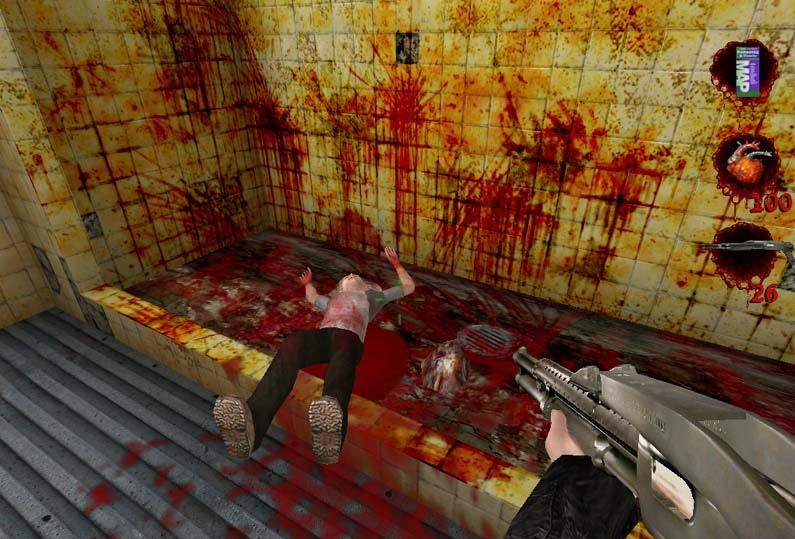
A mindless first person shooter (FPS). Most game critics, from well respected websites and magazines, hated the game and it received negative reviews. FPS should at least have some sort of motivation beyond mindless killing. 1up.com review states that Postal 2, "is meant to be rude and crude, but it's also meant to be funny. That can make up for a lack of gameplay if done right. But guess what? Postal 2 isn't funny... In the case of Postal 2, the joke is on the game buyer. "
Thrill Kill
A fighting game so violent that it never came out commercially. But most reviewers got a near final build and it was universally panned. The game went through a number of delays and changes and eventually turned into a Wu Tang clan game. This game was also universally panned. Video game critic and comedy writer Seanbaby said, "The art direction was a combination of a 12-year-old metalhead's Trapper Keeper doodles and a crime scene."
Bad Day L.A.
This game is just one violent act after another with no real purpose, and stars a lead character that is immpossible to care about. A PC gamer reviewer said in their review that it was, "so tasteless that I wanted to scrub myself with Lysol after getting up from the computer." Most video game websites and magazines didn't even bother to review the game.
There are some extremely violent games that did cross over and became well recieved games. It was not because of their violence that they strived but because of the other things the games had to offer.
Mortal Kombat
The game may have brought extreme violence into video games for good but it knew how to do it. It was not only a fairly solid fighting game but also a homage and satire to old kung fu movies. As I mentioned before, later games in the series actually used the violence in a humorous way in order to change the way the game was perceived.
Grand Theft Auto
Enough has already been said before. GTA was a game that used extreme violence to mock our society.
MadWorld
Violence as visual art? Mad World turned blood into the only color on the screen. Watching this game is like watching a black and white pulp comic coming to life. The storyline of the game also realizes how over the top it is and has some humorous commentartors that poke fun of the beat-em-up genre.
God of War
Set in ancient greek methology you cannot realistically portray the subject matter without violence. If you read any old texts that deal with the subject matter it is full of sex, and violence. God of War follows a new character Kratos and his fight against the God of War. It's a new story but it borrows so much from other greek tales and entrenches itself in the mythology that the violence fits the mood of the source material.
Of course not all games are violent but a lot of them are (at least on a very micro level). But even when a game is full of blood and guts it can still be saying something more. In fact, a game has to be more then just violence to survive, considered that a shallow game will be quickly lost in the shuffle when there are many deeper games out there. The media latches on to it because it is the only thing apparent in screen shots and short videos, but if people actually took a chance to sit down and play and look deeper in the games they would see so much more. How would a movie reviewer feel if people dismissed the Godfather just because they saw a bloody horses head?
I have heard GTA (Grand Theft Auto), lumped with other games that are not artistic. I think this is a mistake. Just because a game is not hyper violent and has some crude aspects to it does not mean it isn't artistic. Sure violence for violence sake isn't really art, and its hard to find artistic merit in a lot of games, movie and TV that are nothing more than violence. But GTA goes deeper then that. Violence is the best way they can get their message across. GTA has mulitple layers to the overall game design and all of it has thought and care behind it. I found it very difficult to pick out just one game from the franchise so I am going to do an overall breakdown that can pretty much be applied to all the games.
Freedom
A typical scenes in Grand Theft Auto showing the chaos you can cause.
One of the most thrilling aspects of the GTA games is the sense of freedom. I remember playing the very first GTA with my friend on his PC. We didn't even play a single mission our entire time. Once the game starts up you can basically do anything. You can steal a car, kill random people, take your cars off jumps, ram into oncoming traffic, really anything that seems possible in the game you can do. There is a bit of a guilty pleasure aspect to playing like this but it just shows one of the layers that GTA has. If you want GTA to be a shallow game, it is one. You are not forced to do anything you don't want to do, and if you feel like following your characters story it is there for you, if not you can ignore it.
Of course the game designers gave this freedom at a cost, your actions result in reactions from the game. If you want to run around shooting people, the police will start to pursue you. If you continue your relentless violence the police get more and more forceful to the point where it is near impossible to escape them. There are ways around this, changing the plates and color of your car and hiding in your house for a while, but overall the game does a good job at giving you freedom but with a consquence. The freedom of a GTA game is easily its biggest draw to the public and sadly its the one the media latches on to when trying to slander the game, but there is so much more artisitic merit to the game.
Satire
Does life imitate art, or does art imitate life? I would argue that the makers of GTA think that art imitates life, and it is very clear in making GTA a satire on our real world. As I said before, freedom is the big draw of the game and with that freedom usually comes a great deal of violence. The violence, both caused by you and brought against you, is so over the top it starts to become funny and satirical. If the violence in the game was more realistic (watching people cry, having children in the game, using sexaul abuse all of which the game does not use) it would become distrubing and any right minded individual couldn't play it nor would enjoy it. But the image of a man walking down the street with a bazooka blowing up hot dog stands, goes from violent and scarey and becomes silly.
While the hyper violence in GTA is satire it is a fairly low form of satire. Anyone could pull this off. But again the game is as shallow as you want it to be, if you enjoy that kind of humour then it is there for you, if you want more, GTA has that too. The storylines in GTA games are usually full of colourful characters that are extreme representations of real personalities. When the game shows a politician, he will most likely be the sleeziest politician you have ever seen. When the game has a police figure, chances are that cop is crooked and drunk on his own power. GTA is not afraid to poke fun at authority and show us how our society has some dark features even where we think it is safe. Again, they exaggerate these characters to make them more humorous then serious. This way of showing well know figures takes its cue from Monty Python, wich regularly showed people with ridiculous and exagerated personalities. The makers of the GTA series are from the UK so british humor should influence them.
Usually the lead character in the game is the only intelligent figure, even though he is also a criminal. The hero may be a criminal but for the most part he is sympathetic. The fact that a criminal is the hero among many other characters in the game speaks volumes on how strange the world of GTA is.
Finally on a deeper level the Satire encompasses even the smaller aspects of the game. If you watch TV in GTAIV there are plenty of shows that spoof our own TV programs, and are loaded with social commentary. The radio in all the games pokes fun at the various music genres with the DJ being an exaggerated colour commentator. The talk radio stations are full of left winged and right winged bias (depending on what channel or show you are listening to) to show that no one or now political view is safe and they all have flaws.
Republican Space Rangers is a show you can watch in GTA IV. It pokes fun the anti-immigration movement, racism, right wing politics, and nationalism. Just like the GTA games the show is overly violent to expose its true ridiculous nature.
A sample of the talk radio in GTA: SA. It covers everything from "bogus" gurus to the "liberal media." If you are interested in more follow the youtube link.
GTA III
A surprise success since the previous 2 GTA games had only limited appeal. Set in the early 2000s (when the game was published), it was the first GTA to go 3D, as well as add more layers of depth to the freedom and realism in the game. This game added the many fully tuned radio stations with licensed music. While it seems rather trivial to add radio to the game it made the game seem more real, since the radio was so fully realized that it was basically like having an actual radio in your car. Also bringing the game into 3D made it easier for the player to fully immmerse him/herself in the game. GTA III brought in a few other small touches to give the player even more freedom, they could drive a taxi around the city and pick up fares, drive an ambulance and save lives, and use police cars to stop criminals. All these extra touches made the world more well rounded and real. The game was set in Liberty City and the whole city is basically a satire on New York City. It had some similiar features to the real world New York but looked different enough to hold its own identity.
The lead character was a Silent Protagonist that was never even given a name (they mention his name in a later game but you go through all of GTA III not knowing it). I have already mentioned how a silent protagonist is effective in an earlier blog. The designers must have used a silent protagonist in this game to yet again give the player more insight into the game. The lead character was rather plain looking and it is not hard to project yourself on to him, and use your internal dialogue as his voice in the game.
GTA Vice City
Vice City did had a new and different direction then GTA III. First off the lead character was no longer silent, he was a loud, tough, mob boss. The game is no longer set in a contemporary times, but in the 1980s. Vice city is very different from Liberty City in both look and feel. Vice City is a satire of Miami, so it had a more tropical and southern flare to it. Overall GTA Vice City was a homage/spoof on the movie Scarface. It was an interesting choice to give GTA more of a focus in its presentaton and it is something that has stuck ever since. Vice City was the first game where the city itself was more of a character, and it influenced the architecture and fashion of the game.
Tommy Vercetti, the lead character, was a lot less likable then any other lead in a GTA game before or since. Its clear that he is a criminal and even though he is still the most intellegent person in the game, he is still a large part of the overall satire. However, having this truely evil lead character is needed to capture the feel of Scarface, which itself starred a horrific character.
GTA San Andreas
GTA: SA, San Andreas. Is the first and only GTA game to be set in a state with multiple cities. The state of San Andreas includes Los Santos (Los Angelas), San Fierro (San Fransisco), and Las Venturas (Las Vegas). The game is set in the early 90s just as gangster rap and gang life is entering popular culture. Out of all the GTAs this one is the largest and has the most off the wall plot. You play as the likeable CJ, who has just returned home after his Mother was killed. The entire game CJ just wants to find out why his mother was killed and is trying to make something of himself on the streets. The storyline spirals out of control and turns from a satire on medias portrayal of "street life" to a truely ridiculous plot involving breaking into Area 51 and stealing a JetPack. Luckily this storyline really thrives in the ridiculous and insane, and just enhances the idea of freedom and satire in the GTA world. Keeping the story wacky helps it not become too depressing since the lead character does deal with heavy material (gang life, gang violence, betrayal, drugs, police brutality, and the death of his innocent mother). With the crazyness the designers are giving the mass public something they enjoy from the GTA series while still getting their message across on a different level.
The other thing that made GTA:SA stand out from the other games was the character development. Your character would gain muscle from working out and lose weight from running. If CJ spent to much time at the burger shop he could become obese. The more you drove, ran, swam, and rode your bike the better your character became at doing those tasks. CJ was a different character at the end of the game than he was at the beginning.
GTA IV
Finally GTA IV returned to a contemporary setting (2008) and Liberty city. GTA IV took a lot of risks and reigned in much more than GTA:SA did. the plot is much more focused and is not as humorous. The story revolves around an Eastern European immigrant finding out that the american dream is not all its cracked up to be, and finds his brother already involved in the wrong crowd. Niko, your character, is also a war vet who is damaged from what he experienced. The freedom is still there but once you enter the main storyline the game really hits you much harder. In some cases you have to make tough choices on who you trust and are given an option to kill one person or another. Whoever you decide to kill is gone from the game and their absence has an impact throughout. Your freedom has more consquences this time not only on a threat level, police chasing you, but also on an emotional level. The comedic-satire still exisits when you listen to the radio, or watch TV. GTA IV has a wide variety of radio and TV to watch and listen to and they often contain a lot of political commentary, or snide remarks about our culture.
The one new feature GTA IV added was relationships. You could gain friends and girlfriends. Just like in real relationships you have to keep up with them (by calling them and going out on a regular basis) in order to get closer. Your dates would even complain if you wore the same clothes more than once. One the flip side if you bothered someone too much, they would start refusing to see you since you are being too clingy. The people around you are almost as well rounded as the lead character. This makes the world seem more real and gives the player more reason to care about those around him/her.
GTA is an artistic series, it just is a form of art we do not always recognize. GTA can be a game that is a simple violent kill spree, or it can be a heavy story driven game with a deeper meaning. Just like the freedom the player has in the game, we have a freedom to interpret GTA more than any other game. Since the game has this layer of depth it shows how creative the designers of the game are. It takes a lot of skill to make a game so well rounded that it fits with many players tastes. On the narrative side of the game the designers chose to play with cliches and satire in order to maintain a higher form of commentary throughout. They chose to make their game not only fun but also say something about the society we live in. GTA is an exageratted world but when you take it down a few notches you can see that it is very close to what we see around us. Yet again this adds another layer of depth this time in the stoytelling aspect. Some people may see the game as "kill this. go there. kill this." Others can see it as a story about all the things wrong in the world. The GTA series is a sandbox game that has many possibilities both in gameplay and story and it is up to the player whether they see it as art or not. It shouldn't be a surprise how I see the game. What do you think?
 Castlevania Symphony of the Night was a large game with many diverse sections of the castle to explore freely. Rather than freeze the game between areas, each section of the castle was joined by a tunnel. The time it took to run through the tunnel was the time it took to load the area.